Last time I buried H-001, the basic Gap&Crap. On the years nobody had touched, the edge didn’t hold up. And almost right away the old trader’s voice in my head started up: “You just got in too early. You should have let the stock run out of air first.”
Where the idea comes from
It’s not a new thought. In 2018 there was a post called FUD YOU, about short sellers getting carried out on the first up day, because everything that flies “has to come down”. And at the end of that same year, going through my manual Gap&Crap backtest, I wrote about patience: every guru tells you “wait for the setup, be patient”, but do you know what exactly you’re being patient for, and has your patience actually paid off?
That’s where the intuition comes from. If you short the first small crack downward, you often get stopped out and the stock keeps going up. If you wait for a whole half-hour bar to break, you should get fewer false entries.
That’s how H-007 came about. Its card says the unpleasant part up front: it’s not a new strategy, it’s variant number 36 of the same Gap&Crap. The H-001 family had already racked up 35 before it.
What was tested
The rule in words: everything as in H-001 except one thing. The short is opened not when price breaks the low of a 5-minute bar, but when it breaks the low of the last closed 30-minute bar. Stop, exit at the close, position size and stock selection are the same as in H-001. I named one timeframe, 30 minutes, before the run. No other timeframes were tried.
The idea had a downside too, and it was written into the card in advance. The entry comes later and lower, so there’s less move left before the close. The stop above the high of day is further from the entry, so with the same $100 risk the position is smaller. The question was which side would win.
Window: 2025-01-02 to 2026-09-10, one run. To be upfront: this window isn’t clean. As I wrote in the last post, we had already “burned” 2025–26 on H-001: the strategy had been run on it, and about 100 Gap&Crap trades from it went into calibrating costs. So a good result here would only have been weak confirmation, not an exam.
For comparison, the usual 5-minute entry was run on the same window with the same costs. That’s a control, not a pick-the-better-of-two. It was written down in advance: 30 minutes is only interesting if it beats the control.
The kill criteria were also written down before the run. If the mean after costs is not above zero, the hypothesis is dead. If the total is negative without the five best trades, it’s dead too.
The result
Costs are the same as in the H-001 final check: commissions, costs from real quotes with a 500 ms delay, and 1% for the locate.
- 30 minutes: 545 trades, mean −0.0312 R, interval [−0.0801; +0.0159]. Total −$1,701.75, and −$2,571.89 without the five best trades.
- Control, 5 minutes: 691 trades, mean +0.0091 R, interval [−0.0615; +0.0811]. Total +$632.12, and −$1,301.95 without the five best.
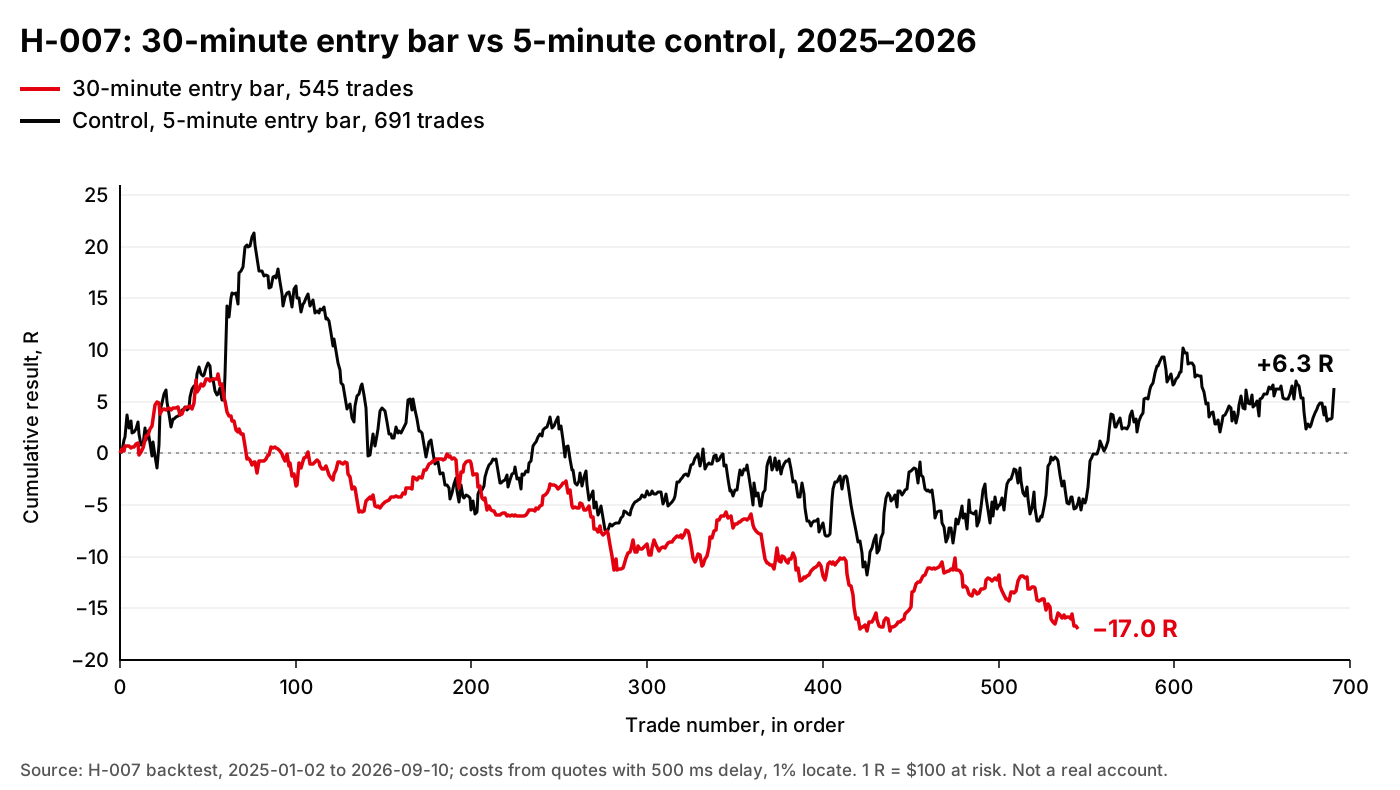
Cumulative R by trade, 2025-01-02 to 2026-09-10: 30-minute entry bar (545 trades) vs the 5-minute control (691 trades).
Both kill criteria fired: the mean is below zero, and without the five best trades the total is negative. Verdict: dead.
The interesting part is that the intuition was half right. Getting stopped out really did become much rarer: 59 stops versus 169 for the control. But there was almost nothing left to earn at the close either: trades that lived until the close made +0.1057 R on average, against +0.4144 R for the control. While you wait for confirmation, the main move happens without you. That’s exactly the price the card warned about.
It didn’t get better in any cut. By year: 2025 −0.0257 R, 2026 −0.0391 R. Every sensitivity check is negative too: a 250 ms delay instead of 500 gives −0.0261 R, the engine’s own costs without quotes −0.0141 R, and even the mildest cost assumption −0.0033 R.
The pre-declared control for junk in the data didn’t change the verdict either. Reverse splits draw fake gaps, and 9 such trades turned up. Without them there are 536 trades and a mean of −0.0317 R. Still dead.
What I took from it
Every attempt to rescue an idea is one more variant. “Just wait a bit” feels like a small tweak, not a new strategy. But a tweak thought up after the base version died is one more attempt from the same family. We had 36 of them. The more attempts, the better the odds that one of them “works” by luck. So I’m actually glad 30 minutes didn’t work: explaining why a lucky variant 36 out of 36 isn’t curve-fitting would have been much harder.
A window you’ve already seen confirms weakly, but it buries just fine. If 30 minutes had shown a profit on 2025–26, that profit would have been worth little: we’d already seen those years and calibrated costs on them. A loss is a different story. Nobody tuned the rule to lose, and the loss holds under every cost assumption. Dead on a seen window is still dead.
There’s almost no untouched data left for this family. The card says it plainly: if I want to try yet another timeframe, the only honest way to test it is paper trading going forward. The hypothesis generator isn’t proposing any more entry variants for this setup, and I agree with it.
I used to say patient traders get the best trades. Maybe that’s true for some setups. For this one the numbers say otherwise: patience just moves the entry to where the money is already gone. Boring, but it took one run instead of six months of trading.
Sources
- H-007 verdict
- executor’s report on the H-007 run (30 minutes vs the 5-minute control)
- H-007 control with flags for fake gaps from reverse splits
- H-007 hypothesis card
- hypothesis registry
- first post: https://algos.trade/en/blog/from-discretion-to-honest-tests/
- https://speculari-fund.blogspot.com/2018/03/TREJDERY-U-KOTORYH-NET-BUDUShhEGO.html
- https://speculari-fund.blogspot.com/2018/12/VSE-MODELI-OShIBOChNY-NO-NEKOTORYE-POLEZNY.html